
Why World Water Week 2026 Proves Water Is Really a Mechanical Engineering Problem
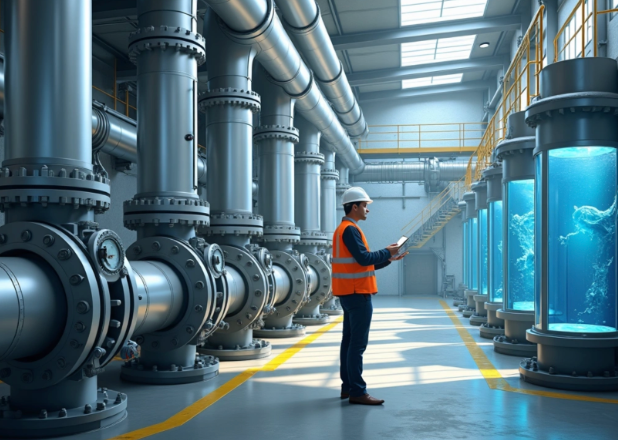
World Water Week 2026 carries the theme 'Water for People and Progress', a framing that aligns precisely with what our practice has long understood. Water security is, at its core, a mechanical engineering problem. The event will examine safely managed drinking water systems and their role in human development and resilience, subjects that fall well within the technical scope of our discipline.
The program will place climate change threats to ecosystems and human well-being squarely on the table. For mechanical engineers, this is the right conversation at the right time. Water usage in mechanical engineering and the downstream impact of our project decisions shape these outcomes in measurable, tangible ways. This August, World Water Week creates a focused opportunity to demonstrate how rigorous infrastructure design, system optimisation, and technically sound sustainable solutions directly advance water security and climate resilience - not as aspirational goals, but as engineered outcomes.
What World Water Week 2026 Reveals About Global Water Challenges
The data surrounding World Water Week 2026 does not suggest a systems challenge - it confirms one. Recent assessments show 2.1 billion people globally still lack access to safely managed drinking water. That figure represents one in four people worldwide. The sanitation picture is worse: 3.4 billion people remain without safely managed sanitation services.
The numbers hold specific weight when broken down by context. Safely managed drinking water coverage in fragile states falls 38 percentage points below that of stable countries. Rural communities have seen coverage move from 50 percent to 60 percent between 2015 and 2024, a decade of effort for a 10-point gain. Low-income countries require a sevenfold increase in basic water infrastructure just to reach universal access targets.
Climate change has compounded what is already a structural deficit. Experts now characterise the climate crisis as, fundamentally, a water crisis - expressed through floods, droughts, and accelerating infrastructure deterioration. Urban water systems designed generations ago were not built for present climatic conditions. The financial shortfall reflects the depth of the problem: annual spending in the water sector must increase by $104.35 to $111.82 billion, nearly tripling current levels. Addressing the global infrastructure gap in full carries a $6.5 trillion price tag.
World Water Week 2026 draws a direct line between these challenges and the mechanical engineering capabilities required to address them - across design, distribution, and treatment systems.
How Water Problems Are Actually Mechanical Engineering Problems
Water challenges are mechanical engineering challenges. That distinction matters. Pressure management alone determines whether water reaches end users or dissipates as loss before it arrives. Optimal pressure minimizes system waste. Excessive pressure risks pipe rupture; insufficient pressure triggers bursts. The outcome, in either direction, is a mechanical failure.
The numbers confirm the scale of the problem. Waterworks waste 40% of water on average worldwide and 26% across Europe, driven by errors, leakages, and pressure mismanagement. The water industry consumes 4% of global electricity today, a figure projected to double by 2040. For municipalities, water systems account for up to half of the total energy expenditure.
This is not a policy deficit. Water distribution networks are assemblies of pipes, reservoirs, pumps, valves, storage tanks, and sumps. Each component demands precise mechanical design and calibration. The performance data supports this directly: improved pressure management produces a 38% reduction in operating pressure and 53% fewer new pipe breaks. Proper mechanical controls reduce energy consumption by 20-40%.
Treatment infrastructure follows the same logic. Pumps represent the single largest line item in energy costs across treatment facilities, and Variable Frequency Drives are essential to maintaining operational efficiency at scale. Water usage in mechanical engineering, and the integrity of the systems delivering it, determines whether communities receive safe drinking water or face contamination through compromised distribution.
What August World Water Week Means for Mechanical Engineering
Stockholm will host World Water Week from August 23-27, 2026, with sessions targeting the exact competencies our profession brings to the table. Strategically, the event serves as a direct precursor to COP30 and the UN 2026 Water Conference - forums where implementation decisions will direct infrastructure investments for decades ahead.
The program covers ground that mechanical engineers cannot afford to overlook. Integrated approaches to water and infrastructure planning, with a focus on climate resilience, feature prominently across sessions. Business leaders will make the case for water as a strategic driver of competitiveness and long-term value. The role of artificial intelligence in water management adds another dimension, from the water demands of chip production to the cooling requirements of data centers, the intersection of technology and water infrastructure is no longer peripheral to our work.
Material innovation is another thread running through the event. The U.S. Army Corps of Engineers has identified a clear need for advanced materials, fiber-reinforced polymers, ultra-high-performance concrete, and 3D-printed components, to meet demands around navigation and flood risk management assets. The case for these materials rests on their capacity for rapid deployment alongside high strength, durability, and performance under extreme conditions.
Underlying all of this is a challenge the water industry must confront honestly. The sector has historically been slow to implement change, defaulting to external research institutions to deliver pre-tested solutions before adoption occurs. World Water Week 2026 takes this on directly through discussions on integrated river basin management, community-led approaches, and regenerative design. Workforce development also features, with recognition that practical implementation demands both emerging technologies and the established technical skill sets that experienced engineers carry.
Conclusion
World Water Week 2026 reinforces what sound engineering practice has always reflected: water security depends on mechanical engineering excellence. The event's focus on infrastructure design, climate resilience, and advanced materials confirms the profession's central role in addressing one of the most pressing global challenges of our time. Mechanical engineers who engage with these discussions - on pressure management, treatment systems, and distribution network design - will be the ones shaping whether billions of people gain reliable access to safe water. The work is technical. The stakes are not abstract.


Comments